Sunday, November 24, 2013

Documintation

Types of documentation
before implement the system a documentation should be provided to help user and programmer
Technical documentation:
this type of documentation is produced just for the programmer and the analyst and it help them if any error occur in the system ,and if they are planning to do any upgrading it will help them.

User documentation:
it help the user while he use the program and give tutorial on how use the program
the documentation help the user how to use the program and it include all the things that the user may face on it.

main types of of technical documentation:
1-system documentation
system documentation provide:
-test plans & test result so that the system  analyst can see the results,so if any error occur they can see the problem and remove the error by solving its problem
-what is expected of the data and show how the system must work so he can identify the errors
2-program documentation contain:
-the input and the output that has been used in the system
-the program flow chart that have been produced at the design stage
-the codes that has been used in the current program

the user documentation consist of :
-the purpose of this system
-the hardware & the software that is needed to run the system
-what the user shall do if an error has occurred


.


how the analysis can collect the information

how the analysis can collect information

 Systems analysis is the study of sets of interacting entities, including computer systems analysis. This field is closely related to requirements analysis or operations research. It is also "an explicit formal inquiry carried out to help someone (referred to as the decision maker) identify a better course of action and make a better decision than he might otherwise have made.
its is the first stage on system analyzing where the analysis will analyse the existing system and see how the work get done and how the company make use of its programs and software   


Sunday, October 27, 2013

Using spreadsheets(H.W)


Answers
Questions


Spreadsheet modeling is a computer program that allows you to create, edit and maintain full data in industries like financial services, customer services etc
What is spreadsheets modeling?

1-To create and design
2-Help you in a specific thing like calculations
3-To make the work more easy and interesting as well as attractive
List three uses of spreadsheets
CSV stand for : Comma separated values
What does csv file stand for

Saturday, October 19, 2013

Calculating the ISBN number

((How to calculate ISBN))

hello guys
today am gonna be showing you how to calculate the isbn number(last digit)
Enjoy!!
ISBN numbers are created so that the first nine digits are information 
digits and the last digit, the one you want to calculate, is a check 
digit. This last number helps people notice and correct mistakes that 
might be made in recording the information digits.  

Here is an ISBN number: 0-205-12669-3. The digit 0 indicates the book 
is written for English-speaking people. The number 205 and the number 
12669 identify the publisher and the book published by that publisher.  

The last digit, the 3, was chosen in the following way. Each digit is 
given a weight by using the digits 1 to 10 and counting right to left. 
These weights are added. The sum is:

   0(10)+ 2(9)+ 0(8) + 5(7) + 1(6) + 2(5) + 6(4) + 6(3) + 9(2) + __(1)  

(The digits of the ISBN information numbers are listed in order left 
to right and weighted by counting down from 10 to 1.) The check digit 
is chosen to be a number from 0 to 10 so that this weighted sum is a
multiple of 11. That is, the sum must be divisible by 11. 

Let us see what sum we have so far with these particular nine 
information digits:

   0(10)+ 2(9)+ 0(8) + 5(7) + 1(6) + 2(5) + 6(4) + 6(3) + 9(2) 
     = 0 + 18 + 0 + 35 + 6 + 10 + 24 + 18 + 18 
     = 129

The check digit 3 was chosen because 129 + 3(1) = 132 and 132 is a 
multiple of 11. 129 is greater than 11(11) = 121 and 14 less than 
11(13) = 143. The only possible number from 0 to 10 to use as a check 
digit is 3.
  
Sometimes the only choice for a check number will be 10. Since this is 
a two digit number and cannot be used as such, the Roman numeral 10, 
the symbol X, is used.  

This system for assigning the last number of an ISBN number makes it 
possible to detect errors made by writing a single digit incorrectly 
or by writing a pair of digits in the wrong order.

Codes provide some interesting mathematics!LOL
you can also check this interesting site:
 http://www.hahnlibrary.net/libraries/isbncalc.html

Tuesday, May 14, 2013

Project managment

Project management


Project management is the discipline of planning, organizing, motivating, and controlling resources to achieve specific goals. A project is a temporary endeavor with a defined beginning and end (usually time-constrained, and often constrained by funding or deliverables), undertaken to meet unique goals and objectives,typically to bring about beneficial change or added value. The temporary nature of projects stands in contrast with business as usual (or operations),which are repetitive, permanent, or semi-permanent functional activities to produce products or services. In practice, the management of these two systems is often quite different, and as such requires the development of distinct technical skills and management strategies.
The primary challenge of project management is to achieve all of the project goals and objectives while honoring the preconceived constraints. The primary constraints are scope, time, quality and budget. The secondary —and more ambitious— challenge is to optimize the allocation of necessary inputs and integrate them to meet pre-defined objectives.
To make project management the manager has to consider three main things
1-Cost
2-Time
3-Scope 

Cost:Is about how to use the limited budget as best as they can
Time:Is how to do the project in a specific time and know when to start and to end
Scope:The work that needs to be accomplished to deliver a product, service, or result with the specified features and functions

There is two main chart in the project management:
Gantt chart:
Gantt chart is a type of bar chart, developed by Henry Gantt in the 1910s, that illustrates a project schedule. Gantt charts illustrate the start and finish dates of the terminal elements and summary elements of a project. Terminal elements and summary elements comprise the work breakdown structure of the project. Some Gantt charts also show the dependency (i.e. precedence network) relationships between activities. Gantt charts can be used to show current schedule status using percent-complete shadings and a vertical "TODAY" line as shown here. 

Pert chart
A project management tool that provides a graphical representation of a project's timeline. PERT, or Program Evaluation Review Technique, was developed by the United States Navy for the Polaris submarine missile program in the 1950s. PERT charts allow the tasks in a particular project to be analyzed, with particular attention to the time required to complete each task, and the minimum time required to finish the entire project.

Tuesday, March 26, 2013

Stock control

Stock control


Stock control is defined as: "The activity of checking a shop’s stock.
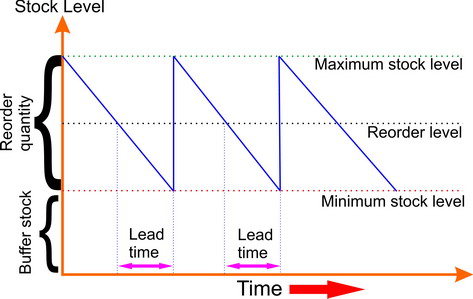
Many shops now use stock control systems. The term "stock control system" can be used to include various aspects of controlling the amount of stock on the shelves and in the stockroom and how reordering happens.
Main features of the stock control is:
  1. Ensuring that products are on the shelf in shops in just the right quantity.
  2. Recognising when a customer has bought a product.
  3. Automatically signalling when more products need to be put on the shelf from the stockroom.
  4. Automatically reordering stock at the appropriate time from the main warehouse.
  5. Automatically producing management information reports that could be used both by local managers and at Head office
There are different types of the stock and the most famous of it is:

1-Raw materisals
2-Work in semi finished goods.
3-Finished goods
4-Consumables
5-Pants and machinery  spare parts


The different between the EPOS and POS:

Point of sale (POS) or checkout is the place where a retail transaction is completed. It is the point at which a customer makes a payment to a merchant in exchange for goods or services. At the point of sale the merchant would use any of a range of possible methods to calculate the amount owing - such as a manual system, weighing machines, scanners or an electronic cash register. The merchant will usually provide hardware and options for use by the customer to make payment.The merchant will also normally issue a receipt for the transaction.

Electronic point of sale System(EPOS) are the computerised systems that are used by retailers: modern tills and associated systems. Their basic functions include scanning bar codes or radio frequency ID (RFID) tags to identify products, scanning credit cards, and cash handling.
EPOS systems do not only handle transactions. They can also connect to networks making information on sales instantly available. This is useful for providing management with information for decision making, and for improving logistics andstock control.
Stock control improves because with exact sales data a retailer knows exactly how much of any given item is available at any given locations as well as how fsat items are selling at each location. This means less working capital is required, while at the same time the chances of running out of any item can be reduced.
Large retailers tend to have very sophisticated logistics systems and the data from EPOS systems is a vital to these

EPOS enables efficient computer stock control and reordering as well as giving a wealth of information about turnover, profitability on different lines, stock ratios, and other important financial indicators. 


Advantages and disadvantages
Stock control systems ensure that just the right amount of stock are on the shelves. If there is too much stock, it ties up a company's money, money that might be better spent on reducing theiroverdraft, on advertising the business or on paying for better facilities for customers, for example. Too much stock means that some perishable products might not sell and would have to be thrown away and this would reduce a company's profit. If there were not enough products on the shelf, they might run out. If this happens, they would lose business and again, profits would not be as good as they ought to be.
Stock control systems save a lot of staff time. Savings may be possible by reducing the number of staff needed in the business thereby improving profits. A stock control system will not remove the necessity for checking what is on the shelves regularly - things get stolen and these won't be recorded.
Stock control systems also mean that a business may have to close down while the system is changed from a manual one. They may also involve a considerable investment in equipment and support. Stock control systems require training and some staff might find them difficult to use. They can also break down so a procedure needs to be in place so the business can continue to trade. This could involve further costs as well, perhaps requiring the purchase of backup equipment or a support agreement. Usually, the benefits of a stock control system outweigh the disadvantages.


Just in time


Just in time (JIT) is a production strategy that strives to improve a business return on investment by reducing in-process inventory and associated carrying costs. To meet JIT objectives, the process relies on signals or Kanban (看板 Kanban) between different points in the process, which tell production when to make the next part. Kanban are usually 'tickets' but can be simple visual signals, such as the presence or absence of a part on a shelf.
Quick notice which requires personnel to order new stock once existing stock is depleting is critical to the inventory reduction at the center of the JIT policy, which saves warehouse space and costs. However, JIT relies on other elements in the inventory chain as well. For instance, its effective application cannot be independent of other key components of a lean manufacturing system or it can "end up with the opposite of the desired result." In recent years manufacturers have continued to try to hone forecasting methods such as applying a trailing 13-week average as a better predictor for JIT planning; however, some research demonstrates that basing JIT on the presumption of stability is inherently flawed.

Ultimate Factory